

Hyponatremia is a common but clinically significant electrolyte disorder that frequently impacts patient management, hospital length of stay, and reimbursement. From both a clinical and medical billing perspective, accurate ICD-10 coding is essential to reflect patient acuity, support medical necessity, and reduce denials. This guide provides a clear, coder-focused breakdown of the correct ICD-10 code for hyponatremia, related codes, documentation rules, and billing considerations—aligned with 2025 ICD-10-CM guidelines.
- What is the ICD-10 Code for Hyponatremia?
- When to Use E87.1
- When Not to Use E87.1
- Related & Alternative ICD-10 Codes
- Documentation Rules Coders Should Verify E87.1
- Services Commonly Supported by E87.1
- Common CPT & HCPCS Code Pairings with E87.1
- Common CPT Codes
- Common HCPCS Codes
- Denial & Audit Prevention Tips
- What is the ICD-10 code for hyponatremia? The correct ICD-10-CM code for hyponatremia is E87.1.
- Is E87.1 a billable diagnosis code? Yes, E87.1 is a valid and billable ICD-10 code for the current fiscal year.
- Can hyponatremia be coded as a secondary diagnosis? Yes, if it affects patient care, treatment, or monitoring.
- Can E87.1 be used for both acute and chronic hyponatremia? Yes. ICD-10 does not differentiate between acute and chronic forms.
- Do abnormal sodium labs automatically justify E87.1? No. Provider documentation and clinical assessment are required.
What is the ICD-10 Code for Hyponatremia?
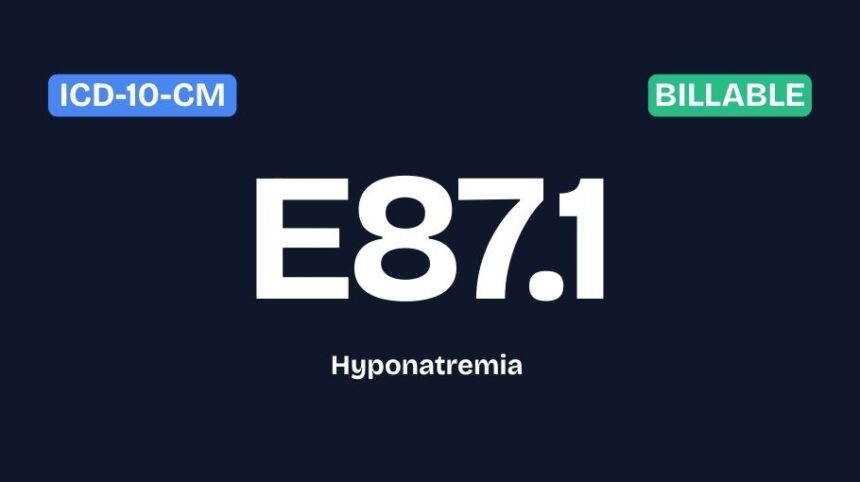
ICD-10-CM Code: E87.1
Description: Hypo-osmolality and hyponatremia
E87.1 is the primary, billable ICD-10 code used when a provider documents hyponatremia and/or low serum osmolality that is clinically evaluated, monitored, or treated.
When to Use E87.1
Use this code when:
- Serum sodium is documented as low (typically <135 mEq/L)
- The provider diagnoses hyponatremia or hypo-osmolality
- The condition impacts care decisions, treatment, or monitoring
- Hyponatremia is a primary reason for the encounter or a clinically relevant secondary condition
It may be reported in inpatient, outpatient, and emergency settings when supported by documentation.
When Not to Use E87.1
Do not assign it when:
- Hyponatremia is only a lab finding with no provider assessment
- The electrolyte imbalance is inherent to a more specific, fully documented condition
- Sodium levels are transient and not clinically addressed
- Documentation is unclear or does not confirm hyponatremia
Coding tip: Lab values alone are insufficient. Provider interpretation is required.
Related & Alternative ICD-10 Codes
Hyponatremia often occurs secondary to other conditions. When documented, additional or alternative codes may be required.
Common Related ICD-10 Codes
- E22.2 – Syndrome of inappropriate secretion of antidiuretic hormone (SIADH)
- E86.0 – Dehydration
- I50.9 – Heart failure, unspecified
- N17.9 – Acute kidney failure, unspecified
- K74.60 – Unspecified cirrhosis of liver
- T50.1X5A – Adverse effect of diuretics, initial encounter
Documentation Rules Coders Should Verify E87.1
Documentation should include:
- Provider-confirmed diagnosis of hyponatremia
- Relevant lab results (e.g., sodium, serum osmolality)
- Clinical significance (symptoms, monitoring, treatment)
- Underlying cause, if known
- Treatment plan (IV fluids, fluid restriction, medication adjustment)
Incomplete documentation is a leading cause of claim denials and audits.
Services Commonly Supported by E87.1
When medically necessary and properly documented, this ICD 10 code may support:
Diagnostic & Monitoring Services
- Basic or comprehensive metabolic panels (BMP/CMP)
- Serum and urine osmolality testing
- Repeat electrolyte monitoring
Procedures & Treatment
- IV fluid administration (normal or hypertonic saline)
- Medication adjustments (e.g., diuretics, ADH antagonists)
- Hospital admission or extended observation
Follow-Up & Ongoing Care
- Inpatient E/M services
- Outpatient follow-up visits
- Specialist consultations (nephrology, endocrinology)
Common CPT & HCPCS Code Pairings with E87.1
While coding varies by payer and setting, this code is frequently reported with:
Common CPT Codes
- 80048 / 80053 – Basic or comprehensive metabolic panel
- 83930 – Blood osmolality
- 99223–99233 – Inpatient E/M services
- 99204–99215 – Outpatient E/M visits
Common HCPCS Codes
- J7030 / J7040 – IV normal saline
- J7050 – IV fluid administration
- G2211 – Complexity add-on (when applicable)
Always confirm payer-specific coverage policies.
Includes
- Clinically evaluated hyponatremia
- Hypo-osmolality with documented sodium imbalance
- Acute or chronic hyponatremia (no distinction in ICD-10)
Excludes
- Isolated abnormal labs without provider assessment
- Electrolyte imbalances not involving sodium
- Conditions where hyponatremia is fully integral and not separately addressed
Denial & Audit Prevention Tips
- Do not code hyponatremia without provider confirmation
- Ensure treatment or monitoring is documented
- Avoid unbundling when hyponatremia is integral to another diagnosis
- Confirm proper sequencing with underlying conditions
- Review annual ICD-10-CM updates for code validity
Accurate documentation and compliant coding significantly reduce audit risk.
FAQs
What is the ICD-10 code for hyponatremia?
The correct ICD-10-CM code for hyponatremia is E87.1.
The correct ICD-10-CM code for hyponatremia is E87.1.
Is E87.1 a billable diagnosis code?
Yes, E87.1 is a valid and billable ICD-10 code for the current fiscal year.
Yes, E87.1 is a valid and billable ICD-10 code for the current fiscal year.
Can hyponatremia be coded as a secondary diagnosis?
Yes, if it affects patient care, treatment, or monitoring.
Yes, if it affects patient care, treatment, or monitoring.
Can E87.1 be used for both acute and chronic hyponatremia?
Yes. ICD-10 does not differentiate between acute and chronic forms.
Yes. ICD-10 does not differentiate between acute and chronic forms.
Do abnormal sodium labs automatically justify E87.1?
No. Provider documentation and clinical assessment are required.
No. Provider documentation and clinical assessment are required.